 Home
Home Contact

Building the Link Behind Singapore's Second LNG Terminal
Big projects begin way before the first shovel even touches the ground.
By the time ground is broken, timelines are already set. Designs are firmed. Interfaces are defined. Some pieces may already be taking shape, sometimes hundreds of miles away in another country. At Jurong Port, SLNG recently commenced construction of Singapore's Second LNG Terminal's Onshore Connecting Infrastructure (OCI). By then, the offshore half of the terminal, the Floating Storage and Regasification Unit (FSRU), had already started construction months ago.
For Desmond Leong, Senior Project Manager leading the OCI works, the construction commencement ceremony felt less like a starting point and more like "catching a running train".
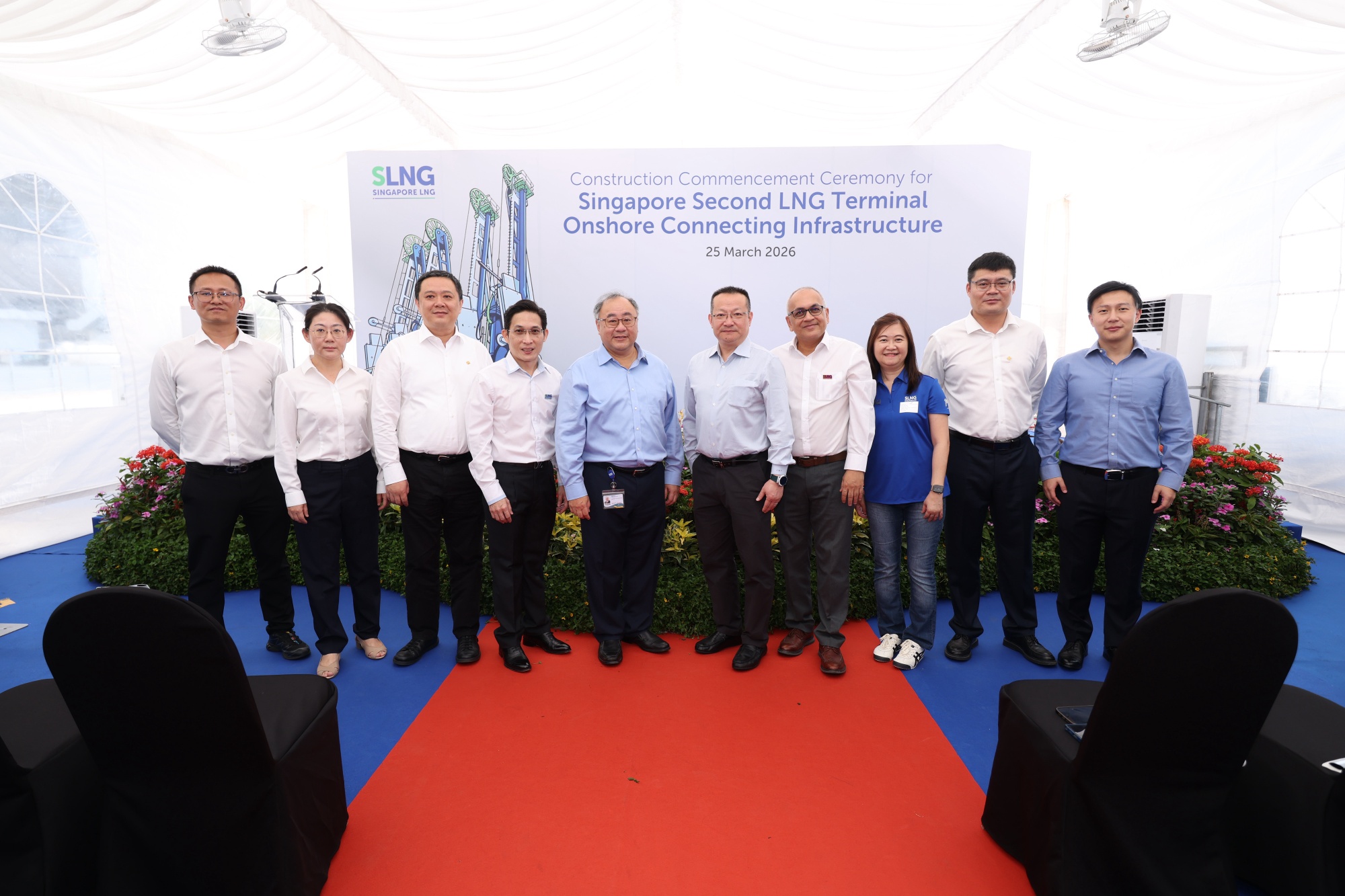
Desmond (fourth from left) at the construction commencement ceremony for the OCI
Keeping Pace
Desmond has spent most of his career working on projects with tight timelines. Before SLNG, his work took him through ExxonMobil and Shell, across refineries, floating production systems, and liquefied natural gas (LNG) facilities. Some of these were projects that had to move ahead even while details were still being worked out.
After years working overseas, the OCI project carried a different weight. Not just another assignment, but a chance to contribute closer to home and to the country. As Desmond recalls with a laugh, it was framed as an opportunity to "come back and do national service".
By the time he stepped in, detailed engineering of the FSRU was already in progress. The endpoint, when the FSRU will be delivered to Singapore, was fixed. So the work is not just to build the OCI but to align. His role, he explains, is closer to that of a "conductor of an orchestra", trying to keep different parts of the team moving in harmony.
That requires a much broader understanding and perspective. "I need to know a little bit of everything broadly, so that I can ask the right questions and make the right calls when compromises are required," he says.
Making the Connection
When completed, the FSRU will be berthed at Jurong Port and will serve as the LNG storage and regasification facility for Singapore's Second LNG Terminal. But that is only half the system. As Desmond puts it, the OCI is the "pipeline bridge" that connects the ship to Singapore's gas network.
The OCI takes the regasified LNG from the FSRU and delivers it into Singapore's natural gas network. From there, it is distributed to various power plants to generate electricity.
Once operational, that connection must keep gas flowing into Singapore's network for decades, without interruption. "It needs to be sending gas into the network continuously and reliably," Desmond says. "That doesn't mean no maintenance, but rather maintenance on the run, without stopping operations."

Desmond (fifth from right) with some of his team members and contractors at the project construction site
Building in a Live Environment
The OCI is being built within Jurong Port, a live environment where operations never really stop. Construction must proceed alongside ongoing port activities that must continue regardless, within tight corridors and next to existing infrastructure that cannot be moved. Pipelines must be routed through (or around) what is already there and connected to the national grid with precision.
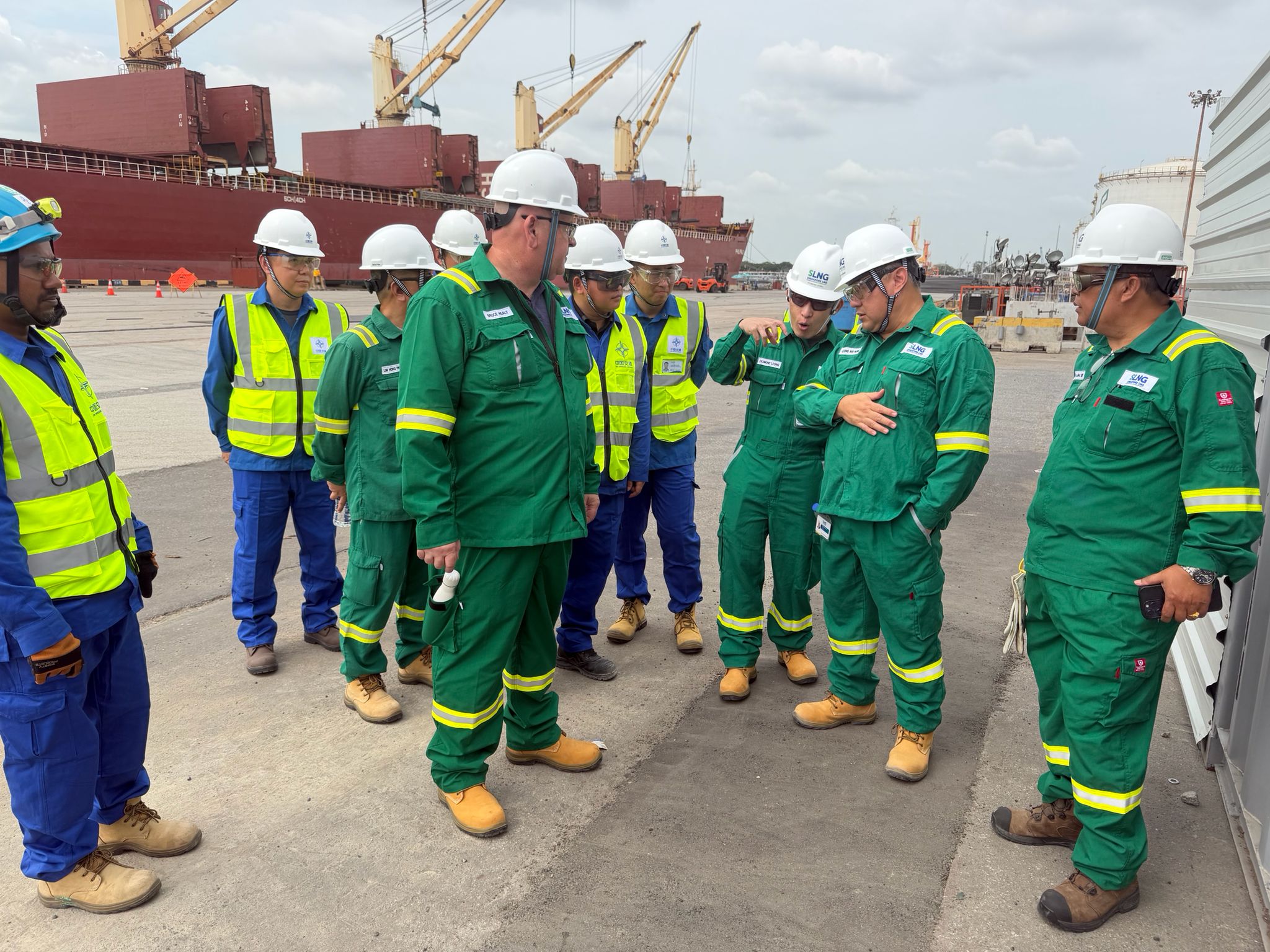
Desmond briefing SLNG CEO Leong Wei Hung during a site visit
Desmond is quick to point out that the challenge is not the engineering itself, but where it sits. "I don't see this project being too complex… other than the interface with Jurong Port," he says." It is a live environment that operates round-the-clock, which means safety and security measures during and after construction must take into account the everyday port activities."
From the outset, the design was anchored on two priorities: operational continuity and public safety. The system is built to keep running, even when individual components need to be taken offline. If one part goes down, another takes over. The flow continues. "Reliability isn't just about the major systems or key pieces of equipment alone," he explains. "It's about the thousands of micro-decisions made during design reviews, safety workshops, and simulation studies."
Ensuring Safety, Security and Reliability
One of the main challenges lies in the coordination: across engineers, regulators, and partners, and across the agencies overseeing different parts of the project. On the onshore side, that includes the Ministry of Trade & Industry, the Energy Market Authority, Jurong Port and SP PowerGrid. It also extends to partners involved in the FSRU construction, including MOL and Hanwha Ocean.
The OCI has also been shaped through countless discussions and dozens of safety and constructability studies. Each tested how the system would perform under different conditions.
For Desmond, that is how confidence in the infrastructure is built – in what he calls the "invisible rigour" behind the design. This comprises the fail-safe logic, automated responses, and constant testing of how the system behaves under stress. Security-by-Design principles, for instance, were factored in from the start. That led to reinforced internal blast walls, increased structural thickness and dual-layered roofing to strengthen the facility against high-impact scenarios.
One of their "quiet wins", as Desmond describes it, was resisting the trap of over-engineering while still delivering a system robust enough to meet high reliability standards. Just as importantly, it remains flexible enough to accommodate future changes, including the replacement of the FSRU if needed.
Delivering when it Counts
With the construction commencement ceremony completed on 25 March 2026, the project has “officially” moved into execution.
The hard thinking has been done. The harder part now is making sure what was designed is carried through to the ground, cleanly, safely, and reliably.
For Desmond, that is the point of all the unseen work behind the OCI. "Knowing that our engineers have stress-tested this system against every conceivable failure allows us to trust that the facility will perform when the nation needs it most."